


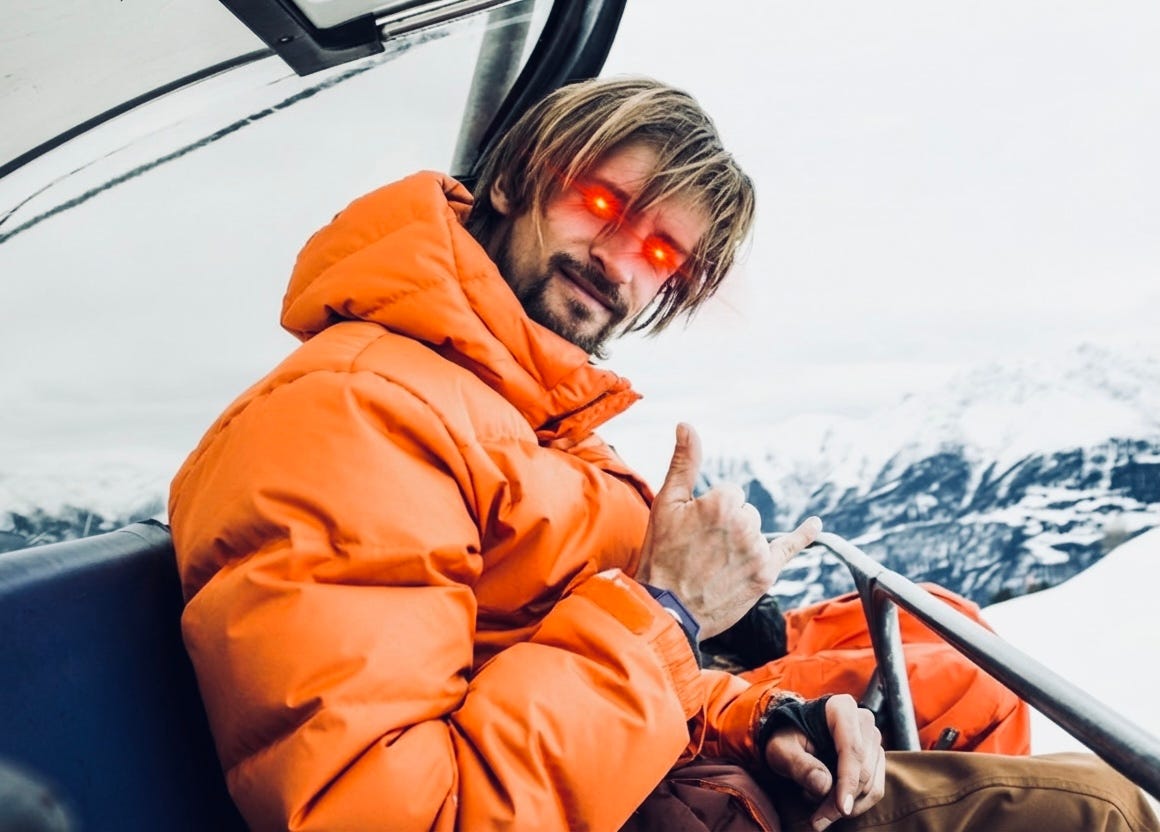
From my seasoned professional and personal perspective, snowboarding’s moral compass is broke. Its semblance of existing media has been in a state of stupor (with notable exceptions), a struggling industry in part its own doing; of a fractured community predominantly forward leaning left into its political ideology; swallowing up narratives of the day, then letting such fodder fester and rot, polarizing its peoples; discounting the revered legacy of its contributive benefactors, all this within something so truly special — where politics should have no quarter.
Let’s be keenly and quite clear: It’s because of those individually and collectively involved, accounted for and assembled rippers, riders, rebels, revelers, and outliers, that has shaped and made the shred scene pretty sweet. The multitude and magnitude of their talents, styles, voices, perspectives and personalities: legends, ladies and gents; lackeys, pros, man-ams, kids on the come-up, are of an inherent and innate quality that compelled so many of us to strap in, bound steadfast, and is an inspired draw for plenty of others new to this pursued form of snow play.
However, in this modern era: Are we now a community that values conformity over free thought and its expression, or one that is brave enough to own its faults and admit when it was wrong … ?
The All-Mountain G.O.A.T.
If you ask a hundred snowboarders to name the greatest of all time, the answers usually split by era or discipline. You’ll hear Travis Rice for the scale, Terje Haakonsen [more on his own expulsion in a future post] for the transition, or Craig Kelly for the foundation. But if you ask who has the most perfect relationship with a mountain, the conversation starts and ends with Nicolas Müller.
To watch Nico ride is to witness a masterclass in fluidity. While the rest of the world was chasing triple corks and robotic, transactional technicality, Müller spent a solid couple of decades proving that the most radical thing you can do on a snowboard is simply listen, in flow state, and respond to the terrain.
The Philosophy of Flow
Müller’s riding has often been described as “organic.” He famously views the mountain not as a series of features to be conquered, but as a partner in a dance. His ability to find side-hits within side-hits—launching off a wind-lip that others didn’t even see—is legendary. He doesn’t just ride the line scripted; he intuits and improvises a melody over it.
His style is characterized by:
The Silent Landing: Even when dropping 40-foot cliffs in the Alaskan backcountry, Müller has a supernatural ability to absorb impact like a cat, rarely breaking his line or the aesthetic of the shot.
Creative Spontaneity: He’s the king of the “no-grab” air and the late tweaked method, prioritizing the feeling of the flight over the math of the rotation.
Terrain Mastery: Whether it’s the slush of Laax or the spines of the Chugach, his edge control remains consistent. He treats every surface like a playground.
The Magnum Opus: That’s It, That’s All
While his career is decorated with iconic parts in films like Lame, Notice to Appear, and his own project Fruition, his segment in the 2008 masterpiece That’s It, That’s All remains the definitive statement on all-mountain riding.
In that film, Müller redefined what was possible on a freeride board. He wasn’t survival-riding down steep faces; he was buttering, spinning, and treating the wildest terrain on earth with the playfulness of a local park. It changed the industry’s trajectory, forcing every major brand to reconsider the all-mountain category.
Why He Still Is The Blueprint
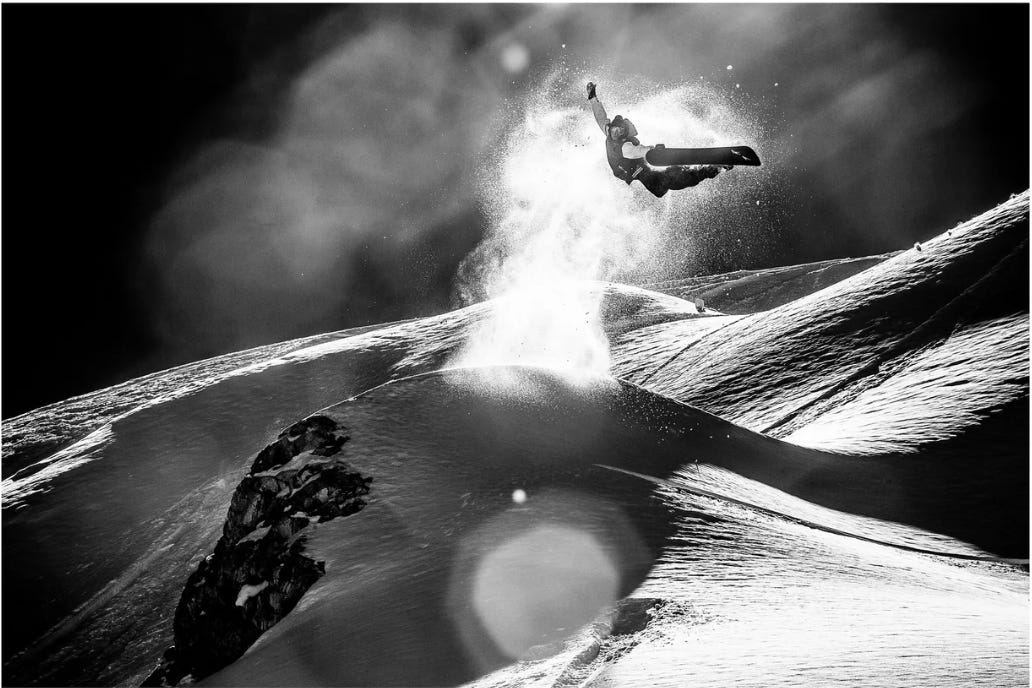
The “Greatest of All Time” title is usually measured in achieved awards. But in snowboarding—a sport rooted in self-expression—the true G.O.A.T. is the one who inspires the most people to actually go out and ride.
Nicolas didn’t just win trophies; he won our imaginations. He reminded us that snowboarding isn’t a performative routine; it’s a creative act. He taught us that the best rider on the mountain isn’t the one with the most revolutions—it’s the one having the most fun, seeing the most lines, and riding with the most soul.
Raise The Alarm
In 2020, as soothsayer and truth teller, taking to his Instagram account of more than 200,000 followers, Müller posted certain positions, perspectives and assertions, among these suggested Bill Gates an implicated architect of the global Covid pandemic, a new world order in realtime formation, about the dangers of 5G radiation, and that U.S. multi-billionaire George Soros is sponsor of a race war.
Have you heard this joke (and its punchline): What’s the difference between conspiracy theory and truth? Six to nine months. [mic drop]
Broken Off
Snowboarding’s community was quick to judge, condemn, and disengage, themselves caught up in the rampant and prevalent propaganda of that moment then — of which is only one part of the greater nefarious fuckery being perpetrated against humanity.
The adopted (unquestioned) narrative, furthered and fueled by publications that editorially praised brands Gnu and ThirtyTwo for severing ties with him, created a public shunning that left many questioning his place in the sport.
In the immediate aftermath, Müller was sanctioned, ridiculed, and written off by those who once celebrated him. Feeds that had featured his legendary style were now silent. The disregard, often conducted with a self-righteous ferocity, was relentless. It seemed the community, in its haste to align with a perceived immoral high ground, chose to dismiss an awakened human being as well as the principle of free thought and open discourse.
“I may not agree with what you say, but I will defend to the death your right to say it.” Elizabeth Beatrice Hall (under the pseudonym S. G. Tallentyre) in her book The Friends of Voltaire.
The Courage of Conviction
It takes a profound, empowered, and yet isolative courage to hold a conviction in the face of stark conflict and unpopular contrast. Nicolas’ situation, in this light, is not just an example of what can go wrong in today’s culture, but a testament to what it means to be truly brave. His image, his platform, and his livelihood—all were sacrificed for a cause much greater, the alerting those within his reach to see and rise against the lies and collusion behind the curtain. This is the very definition of a principle: something you’re potentially willing to lose absolutely everything for, even when the populous of the world has turned against you.
“It’s easier to fool people than convince them that they’ve been fooled.” While this is a quote without specific attribution, it’s relevantly cited in the context of this post and substantive to include.
The Death of Disagreeable Discourse
The politicalization of free speech (and even “hate speech”) and the seeds of divisiveness intentionally sown have led us to a place where genuine debate has been replaced by moral combat. We’ve reached a point, in that any opposition to differing thought and dissenting speak incites an emotionally charged reaction where cognitive reason is nonexistent and dissonance obstructs receptivity. It’s in this alternate climate crisis that we find ourselves. It’s a place for many that if they cannot be “right,” it’s too much to simply be wrong.
This lack of grace and humility has driven a wedge between us and has prevented us from truly appreciating and having understanding for one another.
Dollar, Dollar Bill Y'All
From a brand’s perspective, the decision to part ways with Müller was likely a straightforward, albeit reactionary, business calculation. In an era where a company’s perceived social and political stance is as considered as its product quality, a rider’s core philosophies, antics, or attitude must complement the brand’s image. When an athlete’s actions or beliefs diverge from what a brand’s customer base (speculatively assumed) expects or demands, it’s well within reason to part ways. This is a cold, hard truth of modern marketing—maintaining a unified front and a message can outweigh the contributions of a single individual, no matter how talented.
I’m reminded though of a quote from, Michael Jordan captured on camera in The Last Dance series, and another G.O.A.T., who said “Republicans buy sneakers, too.” Likely, the same could be said about snowboards and respective of Moderates, Independents, and Libertarians.
On the white blank canvas of the mountain, riders come together from all over the world to passionately and purposefully play, relate, learn, and connect. Ultimately, those that possess a certain gravitas of style, a variant of character, and the impression of authenticity and mastery, are the ones who resonate most. They’re more than high school jocks—these are savants who embody the core of the sport, and their appeal extends far beyond technical proficiency.
Snowboarding is for everyone, at its heart, is a choir of voices, and a true appreciation of the culture requires an invitation to hear them all. It’s inherently expressive, artistic, and interpretive. Granted, what’s popular to one or some may not be acknowledged, appreciated, or affirmed by all, and still this very tension is what makes the sport’s culture so rich and vibrant. The push for a single, homogenized viewpoint risks undermining the ethos that has made snowboarding a hub and hive for individual expression and creative freedom.
A few years on, as the truths Nicolas was once vilified for exposing have become obvious and clearer to a wider audience, as positions have shifted and the conversation around these topics is developing, we believe the conscience of snowboarding does, in fact, owe up to one of its greatest a very sincere gesture of accountability.
Though that snowboarding blog was not operating at the time of these events, we’re part of the community today, and we believe it’s our responsibility to take lead in a period of history that must encourage and embrace understanding. A time for a reckoning and recompense is long overdue, so let us be the first to offer our deep, humble apology and welcome a return of the G.O.A.T.
For additional context on his worldview, this video from the Looking Sideways podcast, recorded before the controversy, offers an in-depth conversation with Müller:
