



Salomon is getting huge. The company is chasing $3 billion in annual revenue, and winter sports now account for only a relatively small part of the overall business. There are plenty of interesting corporate stories buried in that number, but most snowboarders probably don’t care how many shoes Salomon sells in New York, Paris or Tokyo. We care about something much simpler: is Salomon still going to make good snowboard stuff?
For snowboarders, that’s really the only part of this story that matters. Salomon has been around snowboarding long enough that it’s easy to take the brand for granted. Its boards, boots and bindings have been sitting on shop walls for decades. The Assassin has become one of those models almost everybody recognizes. The HPS line has given the company room to play with more directional shapes and specific riding ideas, and Salomon has managed to keep a complete snowboard program alive while plenty of larger sporting-goods companies have treated snowboarding like a seasonal category they can turn up or down depending on the year.
So the fact that snowboarding is now a smaller piece of the larger Salomon machine isn’t automatically a problem. It only becomes a problem if the snowboard side starts feeling like one.
The current Salomon Assassin is probably the easiest place to see why Salomon still matters. It’s technically an all-mountain freestyle board, but that label barely explains how people actually use boards like this anymore. The point is that you can leave the lift, hit a side hit, carve a groomer, duck into the trees, take a couple park laps, find some soft snow and not spend the entire day wishing you had brought something else. That’s increasingly what good snowboard design looks like. Not a board that supposedly does everything equally well, because those claims are usually bullshit, but a board with an actual personality that still gives you enough range to follow whatever looks fun.
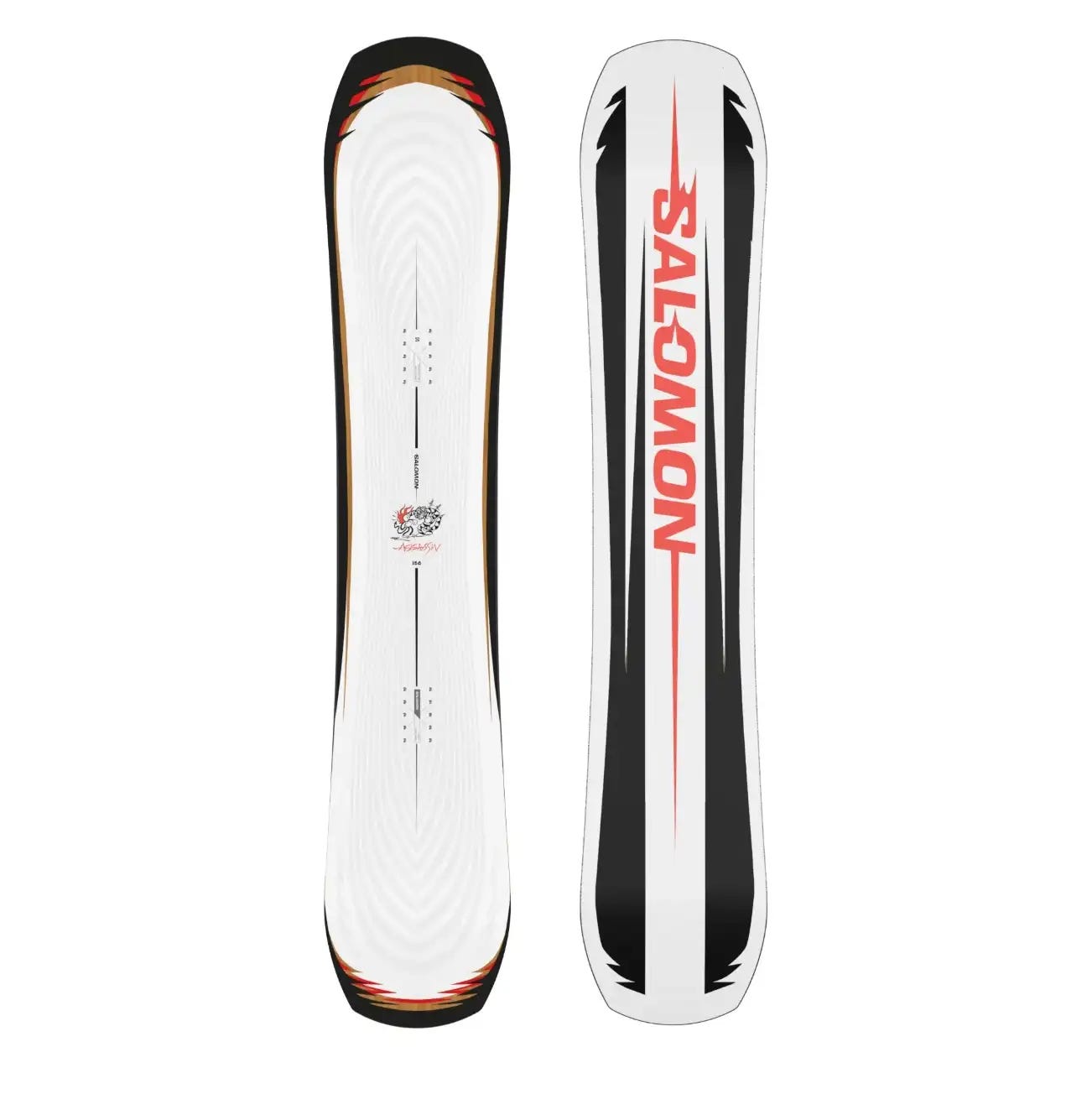
Salomon has understood that for a long time. The Assassin isn’t interesting because it occupies a clever segment on a merchandising chart. It’s interesting because it fits the way snowboarders actually move around a resort. The snowboard industry spent years slicing riders into park riders, freeriders, all-mountain riders, powder riders and whatever other category helped organize a shop wall. Experienced snowboarders have always been messier than that. You ride snowboarding. The terrain decides the rest.
Where Salomon gets more interesting is when it stops trying to make something for everybody. The HPS program has historically given the brand room to explore more specific shapes, rider ideas and terrain preferences. Boards like the Sickstick helped normalize the idea that a directional snowboard could still be playful instead of becoming some stiff missile reserved for AK footage and perfect heelside turns.
That’s exactly the kind of product program a huge company could easily decide isn’t worth the trouble, and that’s why it matters. Snowboarding needs brands with enough scale to make weird things. Not fake-weird graphics wrapped around the same generic shape, but actual weird things: different tapers, different lengths, different sidecuts, boards designed because somebody wanted a particular feeling rather than because a product manager found a hole in a spreadsheet. Big brands can afford to do that. The question is whether they still want to.
If Salomon’s snowboard business eventually becomes a couple high-volume models designed to offend nobody, then nobody in snowboarding is going to care how successful the rest of Salomon becomes. If the company keeps using some of that size to make HPS boards, experiment with materials, support riders and occasionally put something on a shop wall that makes you stop and ask what the hell it is, that’s different. That’s useful.
Snowboarding also doesn’t need Salomon to pretend it’s small. There’s a predictable reaction whenever a snowboard brand gets big where people start wishing it were still some tiny operation running out of a garage. That’s mostly nostalgia. Salomon has resources smaller brands don’t have. It can develop boards, boots and bindings together. It can invest in tooling, materials and testing. It can distribute product around the world and support riders at a level most snowboard companies could never afford.
Good. Use it.
The problem isn’t being big. The problem is when size starts smoothing off everything that made the product interesting in the first place. Snowboarders don’t need Salomon to look underground. We need it to keep listening to snowboarders. There is a huge difference between the two.
The boots and bindings matter here too. Salomon remains one of the companies capable of building the entire snowboard interface instead of just the plank. Boards get the graphics and most of the attention, but boots and bindings determine a huge amount of how a snowboard actually feels. A company that develops across all three categories has the ability to think about the ride as a system rather than three unrelated products sitting beside one another on a website.
That becomes more important as snowboarding gets increasingly distracted by convenience. Fast-entry bindings keep expanding. BOA continues replacing traditional lacing combinations. Every brand wants equipment to be easier, lighter and more accessible. None of that is inherently bad, but ease can’t become the whole objective. Experienced snowboarders will tolerate inconvenience if the product rides better. What they won’t tolerate for long is equipment designed by people who appear to have forgotten that. Salomon has enough history in snowboarding to know the difference. It needs to keep showing it.
There’s another danger when a company becomes much larger than the sport that helped build its credibility: the original culture can slowly turn into marketing material. Old photos, old riders, old graphics, archive drops, heritage language. Then you look at the current product and wonder where any of that attitude went.
Snowboarding already has enough brands selling nostalgia. Salomon’s history only matters if the current snowboard program still feels alive. That means putting good riders on boards, making snowboard films and edits worth watching, building products that reflect what those riders actually want, and supporting the people and places where snowboarding happens instead of simply using mountain imagery to make a larger company feel authentic.
Nobody needs another corporate campaign telling us how important snowboarding is. Make something good and we’ll figure it out ourselves.
That’s ultimately why the $3 billion number isn’t really the story, at least not for snowboarders. The story is what Salomon does with the snowboard side while the company around it becomes dramatically larger. Does the Assassin continue evolving because riders keep pushing it? Does HPS remain a legitimate playground for strange ideas? Do Salomon boots and bindings continue competing with the best snowboard-specific products in the market? Does the team still matter? Do the people running the snowboard program have enough freedom to occasionally make something that a broader corporate organization might not immediately understand?
Those are the questions worth asking.
Snowboarding doesn’t need Salomon to stay small. It needs Salomon to stay interested. Salomon can sell all the shoes it wants. Just keep making snowboards we’d actually want to ride.