


Snowboarding is supposed to go quiet in summer. The lifts stop, the trade-show chatter fades, and the industry disappears into camps, catalogs and edits until the first storm lights everything back up.
That did not happen in 2026.
Between June and August, freeride became an Olympic discipline, X Games started building regional franchises, Shaun White pushed The Snow League into the Southern Hemisphere, and community-led projects opened real doors for riders outside the usual pipeline. At the same time, North America’s summer snow window got shorter again.
It was not a sleepy offseason. It was a preview of the fight over what snowboarding becomes next.
Snowboarding Became a League Sport
X Games is no longer content to be one big weekend. On September 16, it will hold the first Winter X Games League draft in Los Angeles, splitting 40 athletes among four regional clubs: New York, Park City, Whistler and Golden State. Each club gets ten athletes, five women and five men, with skiing and snowboarding represented across superpipe, big air, slopestyle and knuckle huck.
The general managers are not random suits. Dave Sypniewski, Sharalee “Haze” Hazen, Ryan Stutt and Jonny Moseley know the culture, the athletes and the events. Barrett Christy is advising New York. That matters because the league is trying to manufacture regional identity inside sports that have always been built aroun
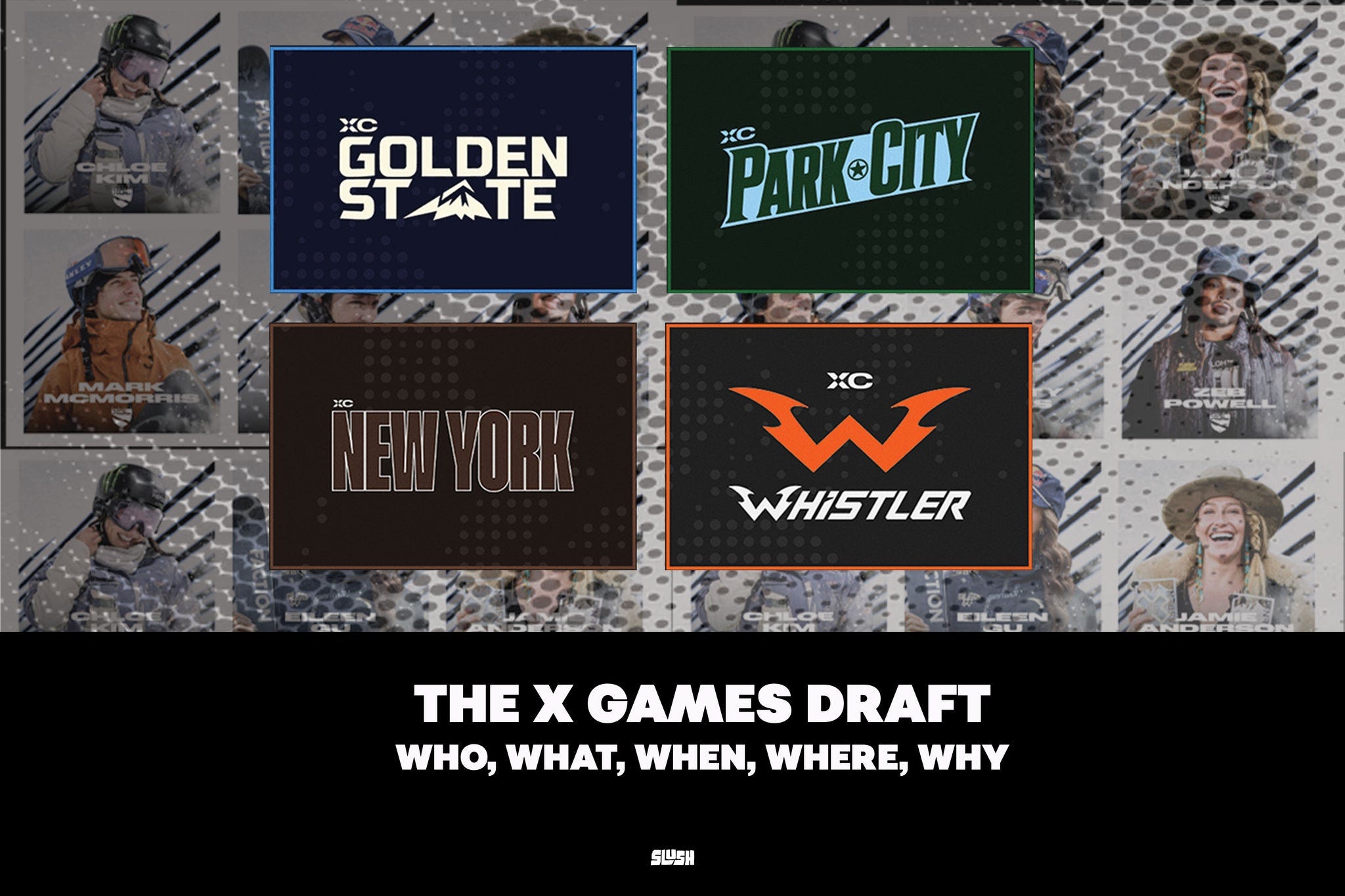
The inaugural Winter X Games League will divide athletes among Golden State, Park City, New York and Whistler.
d individual riders.
The pitch is simple: give fans rosters, points, strategy and rivalries to follow across a season instead of asking them to care for one weekend in January. More continuity could mean more attention, better sponsorships and more stable opportunities for riders. The strange omission is streetstyle, the one format that most naturally connects contests to the clips people actually watch.
Shaun White is attacking the same problem from a different direction. The Snow League’s second season begins with a World Challenge at Cardrona, New Zealand, on September 18 and 19. Sixteen snowboarders and freeskiers will represent North America, Europe, Asia-Pacific and a Challengers team before the regular season goes to Aspen, Park City and LAAX.
The Cardrona format has one genuinely smart idea: a 720 spin cap in the semifinals, followed by unrestricted riding in the final. That gives style, amplitude and line choice room to matter before the tricks go fully nuclear. A one-hit tiebreaker adds another wrinkle without pretending every run can be reduced to a spreadsheet.
Both leagues are solving the same business problem. Snowboarding has elite athletes and huge moments, but it has never had a dependable season-long story for casual fans. More events, better pay and sustained visibility are good. Forced rivalries and sponsor decks are not culture. If the riding turns into content inventory, the audience will smell it immediately.
Freeride Got Its Olympic Invitation, Along With FIS
The biggest news of the summer was also the most complicated. Freeride skiing and snowboarding were added to the 2030 Winter Olympics in the French Alps. A discipline that spent decades defining itself outside traditional contest structures will now stand on the biggest traditional contest stage in sports.
The upside is obvious. Olympic money can expand national programs, create opportunities for riders who cannot bankroll a backcountry career, and show a massive audience the kind of snowboarding many of us actually care about most. The risk is just as obvious. FIS acquired the Freeride World Tour in late 2022, so the existing tour is the likely qualification pipeline. Natural Selection remains outside that system, even though it features many of the riders and venues that define modern freeriding.
Sage Kotsenburg was right to be skeptical about the “FIS-ification” of freeride. A sport built on reading uncontrolled terrain is about to be filtered through the same institution snowboarders already criticize for judging, qualification and format decisions. The best outcome is real investment without sanding off the discipline’s instincts. The worst is an Olympic field selected for navigating a bureaucracy instead of navigating a mountain.
Qualification details will tell us which version we are getting. For now, the validation and the danger are both real.
The Pipeline Kept Getting Wider
Not every important development came with a league office or an Olympic logo. The Uninvited Boarding Pass, created with She’ll Be Right and Burton, is bringing a qualifier to Cardrona on September 26 for women, girls and non-binary riders who have never competed in an Uninvited event. The winner earns a place at the 2027 Utah Invitational and NZ$4,000 toward travel.
That is what legitimate development looks like. Find talent where it lives, create a visible next step, and help remove the travel bill that usually keeps the same people outside the gate.
SEEN’s “Tumble 4 Ya” worked from the other end. The crowdsourced queer snowboard video mixed professionals, beginners and everyone between them. No points. No draft. No attempt to make every rider fit the same level or aesthetic. Just a community making itself visible on its own terms.
That contrast was one of the healthiest things about the summer. Snowboarding can build bigger stages without making every stage look the same. It needs the league and the local qualifier, the Olympic broadcast and the rough community edit.
Summer Snow Kept Shrinking
While promoters talked about year-round schedules, the physical window for summer snowboarding in North America kept contracting. Mammoth closed for the season on June 7. At Timberline, the target was July 19, nearly a month earlier than the previous summer. As we wrote in June, low snow pushed camps to shorten sessions, change plans and look elsewhere.
Slush took the longer view in its report on Mount Hood. Palmer has not been classified as a glacier since the 1980s. Glisan was formally declared extinct in 2023. Every glacier on Hood is receding, and the Oregon Glaciers Institute says roughly half of the named glaciers in the Oregon Cascades have already disappeared or are expected to disappear by 2050.
Summer riding did not disappear. Woodward Copper kept the park moving. Crews dropped edits from Hintertux, Chile and New Zealand. Big Snow continued to prove that an indoor hill in New Jersey can become a real scene when riders treat it like one. Snowboarders will always find a patch and make something happen.
Still, the irony is impossible to miss. Snowboarding is building year-round media products while losing part of the year it has historically used to build riders. Summer camps are not a luxury. They are where kids get repetitions, coaches develop athletes, crews form and the next generation starts to believe it belongs here. Lose that engine and the effects will show up everywhere.
The Rest of the Industry Kept Moving
The summer’s smaller stories all pointed toward an industry trying to professionalize without giving up ownership of its culture. Danny Kass became head coach of the U.S. big air and slopestyle snowboard team, putting one of the most influential riders of his generation inside the national-team structure. That is a long way from the Grenade days, but it also means the people who shaped modern snowboarding are increasingly the ones shaping its institutions.
Riders also kept turning influence into ownership. Zeb Powell built “Zeb’s Closet” with Burton, while Su Yiming launched his own streetwear label, Süugar. Neither move is just another signature colorway. Both put a rider’s taste, name and audience closer to the center of the business.
Burton continued testing seaweed-based TPSea Flex sleeves as a replacement for single-use plastic packaging. Meanwhile, the independent-resort economy showed both sides of the current reality. Utah’s Cherry Peak hit the market for $22.5 million, while the Freedom Pass grew to 21 independent ski areas, giving participating passholders three days at every member mountain. One story says how hard it is to keep a small hill alive. The other shows that cooperation may be the only way many of them compete with the mega-passes.
Even Hollywood noticed. HBO Max picked up “Lifties,” an A24-backed comedy from Jimmy Tatro and Dan Lagana about four mountain-town friends dealing with an acquisition by an “Ikon-like” company. That could be painful. It could also be the first mainstream show in a while that understands resort consolidation is not background scenery. It is the plot.
The Last Word
The summer did not point in one direction. Snowboarding got more professional while its culture stayed decentralized. Freeride gained an Olympic platform while the qualification fight remained unresolved. Athletes built brands and leagues while the glaciers under summer camps kept pulling back.
Growth is not the enemy. Blandness is.
The next questions are simple. Will the new leagues pay riders fairly and let them shape the formats? Will Olympic freeride include the athletes who actually define freeriding? Can summer camps survive a shorter and less reliable season? Can mainstream exposure make snowboarding bigger without sanding off everything weird, local and difficult to package about it?
Snowboarding did not take the summer off. It spent the summer deciding what it wants to become.