


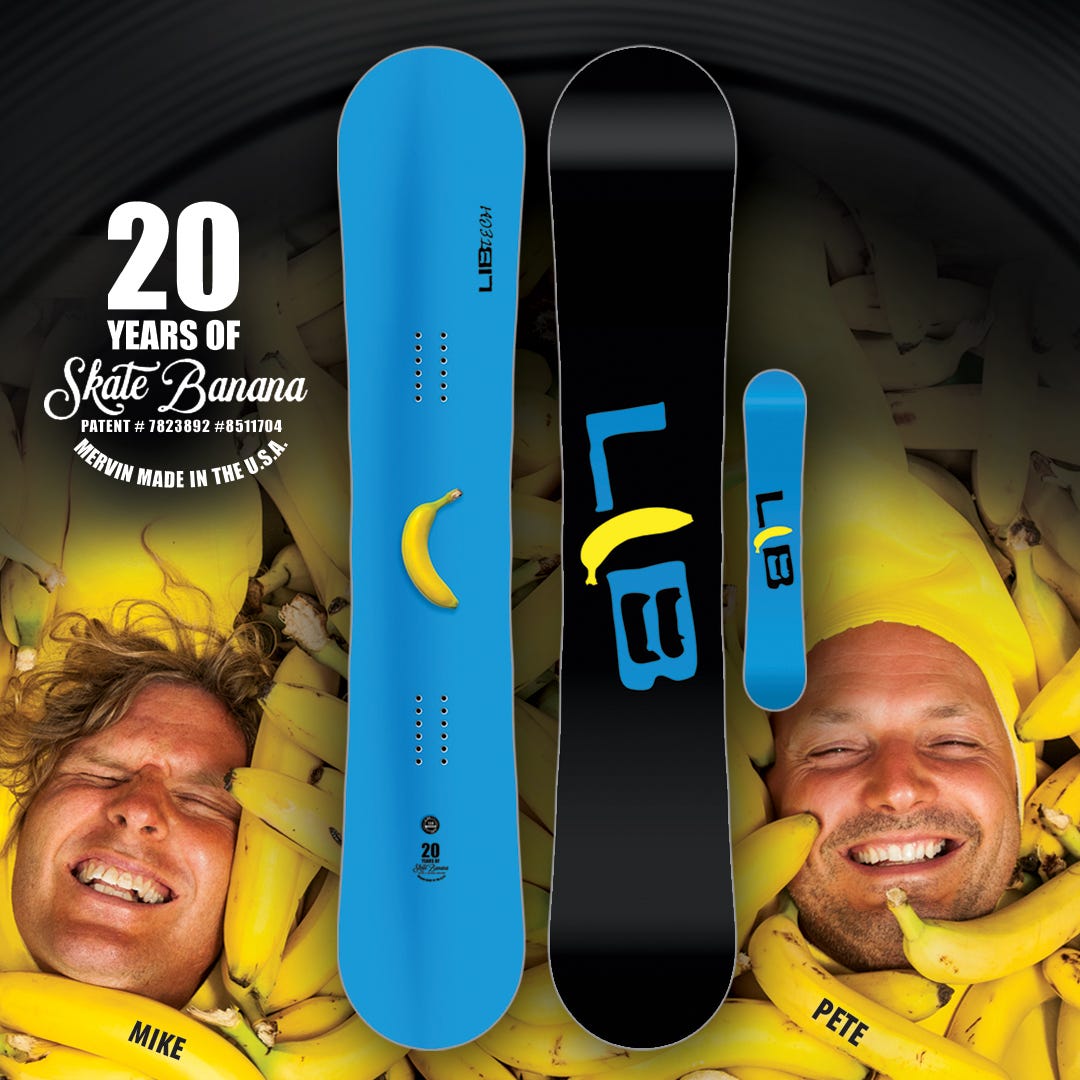
Twenty years ago, Lib Tech introduced a snowboard that pissed off a fair number of traditionalists and changed the way the industry thought about camber. The Skate Banana put rocker between the bindings, added mild camber toward the ends, and gave riders a loose, playful feel that was considerably different from the conventional camber boards most of us had grown up riding.
Some snowboarders loved it immediately. Others thought it felt like riding a wet noodle. Either way, it was impossible to ignore, and within a few years practically every snowboard manufacturer was experimenting with some variation of rocker, reverse camber, or hybrid profiles.
Last week, Lib Tech celebrated the Skate Banana’s twentieth anniversary with a retrospective film featuring co-founder Pete Saari and two decades of riding footage. The current Skate Banana is still built around the same basic idea that made the original controversial, and it still has a place in Lib Tech’s lineup. The 2026/27 version sells for $579.99. Slush Magazine
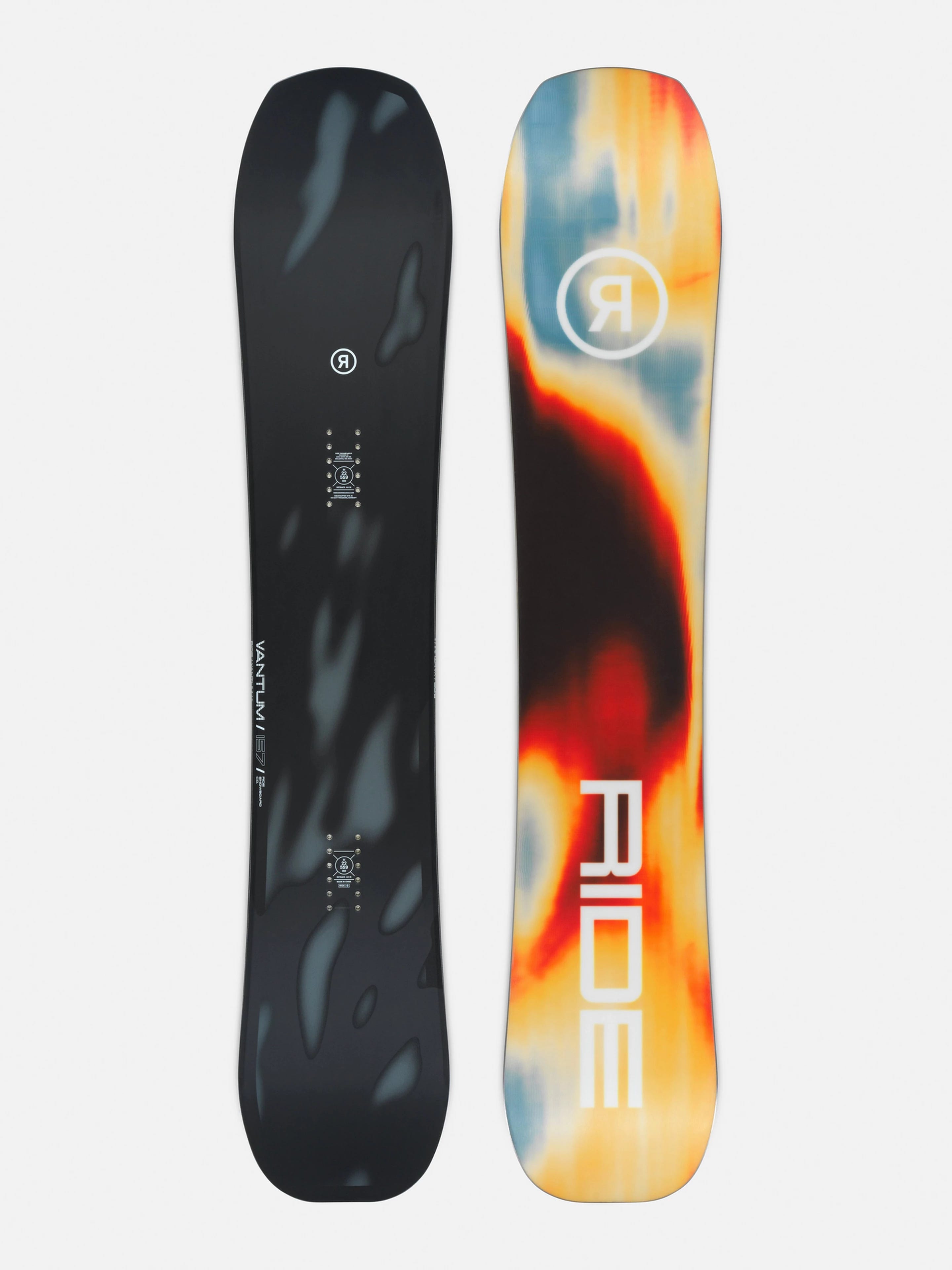
Meanwhile, RIDE Snowboards has a new board called the Vantum, also priced at $579.95. It’s a directional all-mountain snowboard with traditional camber and an interesting construction feature called the Urethane Channel. RIDE mills sections out of the wood core near the nose and fills them with urethane, similar to the material used in its Slimewalls sidewalls. The idea is to reduce vibration and keep the nose from getting knocked around when the snow becomes chopped up. RIDE Snowboards
Two snowboards. Both cost $580.
One is celebrating twenty years of a design that helped change snowboarding. The other is introducing a construction feature intended to make a modern resort board more comfortable and stable in rough conditions.
They’re not directly competing for the same rider, and that’s what makes the comparison interesting. The Skate Banana is a freestyle-oriented twin built around a playful hybrid profile. The Vantum is a tapered directional board intended for groomers, powder, natural hits, and the kind of variable snow most resort riders eventually encounter.
Neither approach is inherently better. But both raise a question that becomes increasingly relevant when you’re standing in a snowboard shop looking at a wall of boards priced between $500 and $800.
What exactly makes a snowboard worth the money?
Twenty Years of Better Snowboards
There’s no question that snowboard technology has improved enormously over the past few decades. Anybody who remembers riding the heavy, stiff, relatively unforgiving equipment of the early 1990s can appreciate how far things have come. Modern boards are generally lighter, more refined, and capable of doing things that required considerably more effort on older equipment.
But the improvements haven’t always come from making snowboards more complicated.
The Skate Banana is a good example. When Lib Tech introduced Banana Technology in 2006, the idea wasn’t to add another exotic material or develop a more elaborate construction process. It was to reconsider something fundamental about how a snowboard interacted with the snow.
Traditional camber had been the dominant profile for years. It worked, and it still works extremely well. Camber provides energy, edge engagement, stability, and the kind of response that many experienced riders prefer. But it also creates a particular relationship between the board’s contact points and the snow, especially when you’re riding slowly, pivoting, pressing, or trying to make the board behave loosely.
Lib Tech’s answer was to change the profile.
The Skate Banana made it easier to pivot and butter, gave riders a more forgiving platform, and introduced a different approach to float and edge engagement. Combined with Magne-Traction edges, the design attempted to maintain grip while allowing the board to feel considerably looser than a conventional camber snowboard.
It wasn’t perfect. It wasn’t supposed to be. Riders who preferred the precision and stored energy of traditional camber weren’t necessarily going to like the way it felt. But for snowboarders who wanted something playful, forgiving, and easy to throw around, it offered a genuinely different experience.
That’s what made the Skate Banana important. It didn’t simply improve an existing snowboard. It gave riders another way to snowboard.
Twenty years later, the industry has absorbed much of that thinking. Rocker, camber, and hybrid profiles are now ordinary choices. Manufacturers combine them with different flex patterns, sidecuts, shapes, and constructions to produce boards with increasingly specific riding characteristics.
The debate over which profile is best never really ended, because there isn’t a universally correct answer.
A snowboarder who spends most of the day carving hard groomers might prefer something completely different from somebody buttering around the mountain and hitting every side hit in sight. Both can be riding excellent snowboards.
The important thing is that they feel different.
Sometimes the Best Technology Is the Stuff You Can’t See
RIDE’s Vantum represents a different kind of snowboard development.
There’s nothing particularly revolutionary about a directional camber snowboard designed for all-mountain riding. Manufacturers have been making excellent versions of that basic formula for decades. The Vantum’s more interesting feature is buried inside the nose, where RIDE has introduced urethane-filled channels intended to absorb vibration.
That’s a legitimate problem worth addressing.
Anybody who rides a busy resort knows how dramatically snow conditions can change throughout the day. A groomer that feels perfect first thing in the morning can turn into a collection of scraped-off patches, piles of pushed-around snow, and unpredictable little bumps by lunchtime. A board that feels smooth and stable on fresh corduroy can become considerably less enjoyable when the surface gets rough.
Nose chatter is part of that equation. When a board’s nose begins vibrating through uneven snow, some of that movement can affect how settled the board feels underfoot. The amount depends on the board’s construction, flex, speed, snow conditions, and the rider.
Manufacturers have been trying to manage vibration for years. Rubber, urethane, carbon, fiberglass layups, wood-core construction, and other materials can all influence how a snowboard responds to impacts and high-frequency movement.
RIDE’s Urethane Channel is another attempt to improve that relationship.
The company says the construction helps stabilize the nose in chopped-up conditions. That’s the design objective, not an independently established performance result. Until riders have spent meaningful time comparing the Vantum with similar boards, it’s difficult to say how noticeable the difference will be.
But the thinking behind it makes sense.
Not every worthwhile improvement needs to produce more pop, lighter weight, or some dramatic change in board geometry. Sometimes making a snowboard feel calmer through rough snow is exactly what an experienced rider wants.
For someone spending most of their winter carving groomers, riding trees, and dealing with whatever conditions the mountain happens to deliver, a little less vibration could be more useful than another construction feature designed to make a board lighter.
That’s particularly true if the improvement doesn’t compromise the response and feel that made the board enjoyable in the first place.
And that’s where snowboard design gets interesting. Adding damping is relatively straightforward. Adding the right amount, in the right places, without making the board feel dead is considerably harder.
A good snowboard isn’t simply a collection of impressive materials. It’s how those materials work together when you’re actually riding.
The $400 Problem
There’s another complication facing anybody shopping for a snowboard this fall.
Last year’s boards are still out there.
As of October 28, evo was advertising the 2025/26 Lib Tech Skate Banana for $405.99, reduced from its original $579.99 price. That’s approximately 30 percent off a snowboard built around the same fundamental design that Lib Tech is celebrating this year. Availability depends on size and remaining inventory, but the price difference is substantial. evo
Now imagine you’re shopping for a Skate Banana.
You can buy the current model for $580, or you might find last year’s version for roughly $406. Both carry the same recognizable name and share the basic Banana Technology concept. There may be differences in construction details, graphics, or available sizes, but the question becomes obvious.
What am I getting for the additional $174?
That’s not a criticism of Lib Tech. It’s a question that applies to practically every snowboard manufacturer operating on an annual product cycle.
Snowboards aren’t smartphones. A new model doesn’t automatically make last year’s version obsolete. A good snowboard from 2025 can still be an excellent snowboard in 2026, and there are plenty of riders who would have a difficult time identifying minor year-to-year construction changes in a blind test.
That doesn’t mean snowboard development has stopped. It means the improvements are often incremental.
And incremental improvements can be difficult to sell when the previous version is sitting on a clearance rack for hundreds of dollars less.
Of course, buying last year’s equipment comes with compromises. You might not find the size you want. The graphic might not appeal to you. The board may have been changed in ways that actually matter to your riding. And sometimes the current model is simply the better choice.
But the discount forces a legitimate conversation about value.
A snowboard doesn’t become worse because a new catalog comes out.
That’s one of the strange things about the equipment business. Manufacturers need to introduce new products, retailers need to move inventory, and customers have become accustomed to waiting for discounts. The result is a market where a perfectly good snowboard can lose a substantial portion of its retail price without losing any of its ability to snowboard.
For experienced riders, that’s an opportunity.
For brands and shops, it’s a difficult problem.
More Technology Doesn’t Automatically Mean More Fun
The snowboard industry has become incredibly good at describing equipment.
Every board has a detailed construction story. There are carbon stringers, specialized fiberglass configurations, proprietary sidecuts, lightweight wood cores, damping materials, three-dimensional shaping, and enough trademarked terminology to make a fairly simple piece of equipment sound like something developed for NASA.
Some of those features genuinely matter. Others make relatively small differences that may only become noticeable under particular conditions. And some are simply different ways of accomplishing things manufacturers have been doing for years.
The challenge is figuring out which ones actually improve the riding experience.
That’s not always easy, especially when nearly every all-mountain snowboard promises some variation of the same thing. It carves groomers, floats powder, handles trees, hits side hits, and somehow remains playful enough for the park.
Apparently every snowboard is now designed to do everything.
The reality is that good snowboard design still involves compromises.
A board built to feel loose and forgiving isn’t necessarily going to provide the same response as a stiff directional charger. A heavily damped board might feel fantastic through chopped-up snow but less lively underfoot. A lightweight construction can improve maneuverability while changing how the board handles vibration. A wide, volume-shifted shape might float beautifully but require a different approach to turning.
None of those characteristics automatically makes a snowboard better or worse.
They make it different.
And that’s something snowboard companies could do a better job explaining.
Rather than telling us every board is an incredible all-mountain machine, tell us what it does particularly well. Tell us what kind of rider will appreciate it. Tell us where it feels most comfortable and where it starts to become less enjoyable.
A snowboard designed around a specific riding experience is considerably more interesting than one marketed as the perfect solution for everybody.
The Skate Banana has survived twenty years partly because it has a recognizable personality. You know what kind of experience Lib Tech is trying to deliver. The board isn’t pretending to be a stiff freeride weapon. It’s a playful freestyle-oriented snowboard designed to make the mountain feel like a playground.
The Vantum is making a different argument. RIDE is emphasizing directional all-mountain performance, stability, and improved behavior in rough snow.
Those are two distinct ideas about what makes snowboarding enjoyable.
That’s exactly how it should be.
Buy the Board, Not the Technology Story
At $580, snowboarders should expect a well-built board with quality materials, a durable base, reliable edges, and riding characteristics that justify the purchase. But the most expensive construction isn’t necessarily the best construction, and the newest technology isn’t automatically an improvement for every rider.
A snowboard that feels fantastic under somebody else’s feet might feel completely wrong under yours.
That’s why demos still matter. So does talking to somebody who actually knows how different boards ride. Product descriptions and technical diagrams can explain what a snowboard is designed to do, but they can’t completely explain how it’s going to feel when you put it on edge or hit your first unexpected patch of chopped-up snow.
And they certainly can’t tell you whether you’re going to have more fun on it.
The Skate Banana’s twentieth anniversary is a reminder that a genuinely good idea can remain relevant for decades. RIDE’s Vantum is evidence that manufacturers are still exploring ways to improve the everyday experience of riding a snowboard.
Both approaches deserve attention.
But the existence of new technology doesn’t automatically make older technology obsolete. Sometimes the best snowboard for a particular rider is the newest model with the latest construction. Sometimes it’s a proven design that’s been around for twenty years. And sometimes it’s last year’s board, sitting on a clearance rack at a price that makes considerably more sense.
The snowboard industry will always need new ideas. That’s how equipment gets better, and it’s how riders discover new ways to enjoy the mountain.
What it doesn’t need is to convince us that every new idea represents a revolution.
Twenty years ago, the Skate Banana genuinely challenged how snowboarders thought about board design. Today, it’s still being sold because enough riders continue to enjoy what it does.
The Vantum is trying to solve a different problem, one that might be particularly meaningful to somebody who spends long days riding increasingly beat-up resort snow.
Neither board needs to be everything to everybody.
And neither needs to justify its price with a complicated story about technology.
The real test comes when you strap in, point it downhill, and make a few turns.
If the board makes snowboarding better for you, it’s probably worth the money.
If it doesn’t, another $200 worth of carbon, urethane, or marketing isn’t going to change that.
all good vibes Nikola Tesla 💙💪